
What do we mean by “Empowerment” and why do we need it for Energy Flexibility?
The BlueBird Approach to End-User Flexibility
As smart energy technologies, and flexible energy use to adapt to renewable energy availability and avoid grid peaks become more common in homes and buildings, a key question emerges: how do we ensure that the people living and working in these buildings are genuinely engaged with flexibility solutions and not just subjected to them?
In the BlueBird project, we use the concept of Empowerment to answer that question. But empowerment, as we define it, is not simply about giving users control or access to information. It is a dynamic process through which occupants and consumers gain the motivation, capability, and opportunity to actively engage with smart energy technologies and flexible energy behaviors, and we reflect on how this evolves over time, shaped by trust, experience, and everyday life circumstances.
Building on Behavioural Science
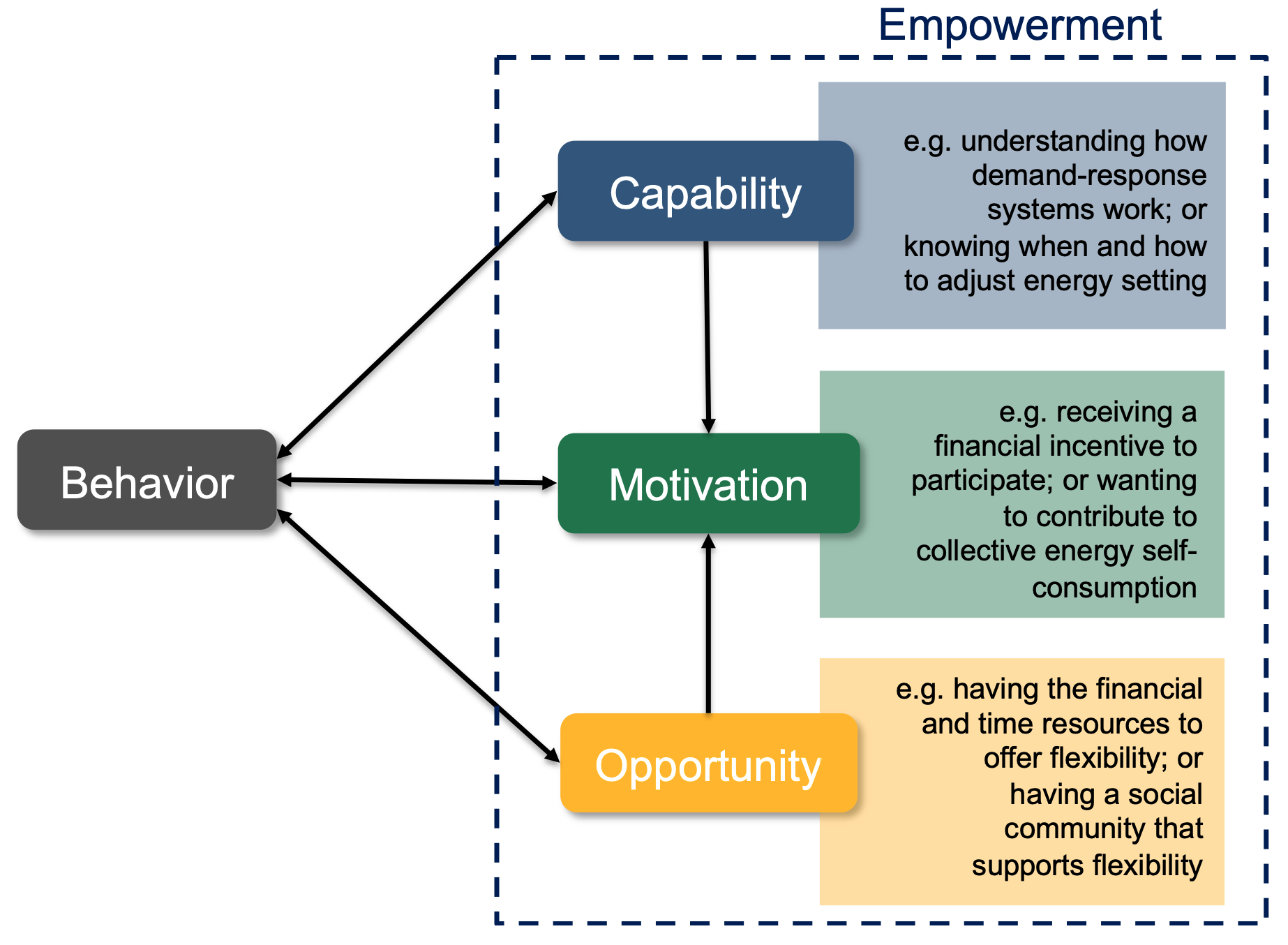
Our definition draws on the COM-B model of behaviour change (Michie et al., 2011), a framework from behavioural science that explains behaviour as the product of three interacting elements:
- Capability — the knowledge, skills, and psychological or physical ability to act;
- Opportunity — the social and material conditions that make action possible;
- Motivation — the goals, values, habits, and emotions that drive behavior.
Behavior change only occurs consistently when all three are sufficiently present. Applying this to energy flexibility, we define Empowerment as the extent to which users are
- Motivated to engage with flexibility solutions or react to flexibility requests,
- Capable of understanding and operating them,
- Provided with meaningful opportunities that fit their social roles and everyday practices.
Why This Framework Guides Our Work
Using COM-B as a lens for empowerment gives us a structured way to identify what supports or hinders flexibility engagement across different buildings, user groups, and national contexts. It helps us move beyond generic assumptions about “user behaviour” and instead ask more precise questions: What do users currently know, and what do they need to know? What practical or social barriers stand in the way of action? What motivates some users but not others?
These questions have shaped the research activities in the social work package in BlueBird, ranging from behavioural science workshops where we explored motivators and barriers with different stakeholder groups, to interviews and focus group conducted around the three COM-B dimensions, to a broader literature review and large-scale studies what predicts flexibility behaviors across countries.