
Hotels as Flexibility Providers
Elektrizitätswerk Hindelang eG (EWH) leads the German pilot in Bad Hindelang in the Allgäu region. In this tourist Alpine area, in addition to a ski lift, hotels are the main large consumers in EWH’s grid. To unlock the future flexibility of the hotels in the valley, EWH is partnering with the hotels Prinz Luitpold Bad, a 4-star wellness hotel, and the Youth-Training-Center hostel of the German Alpine Club.

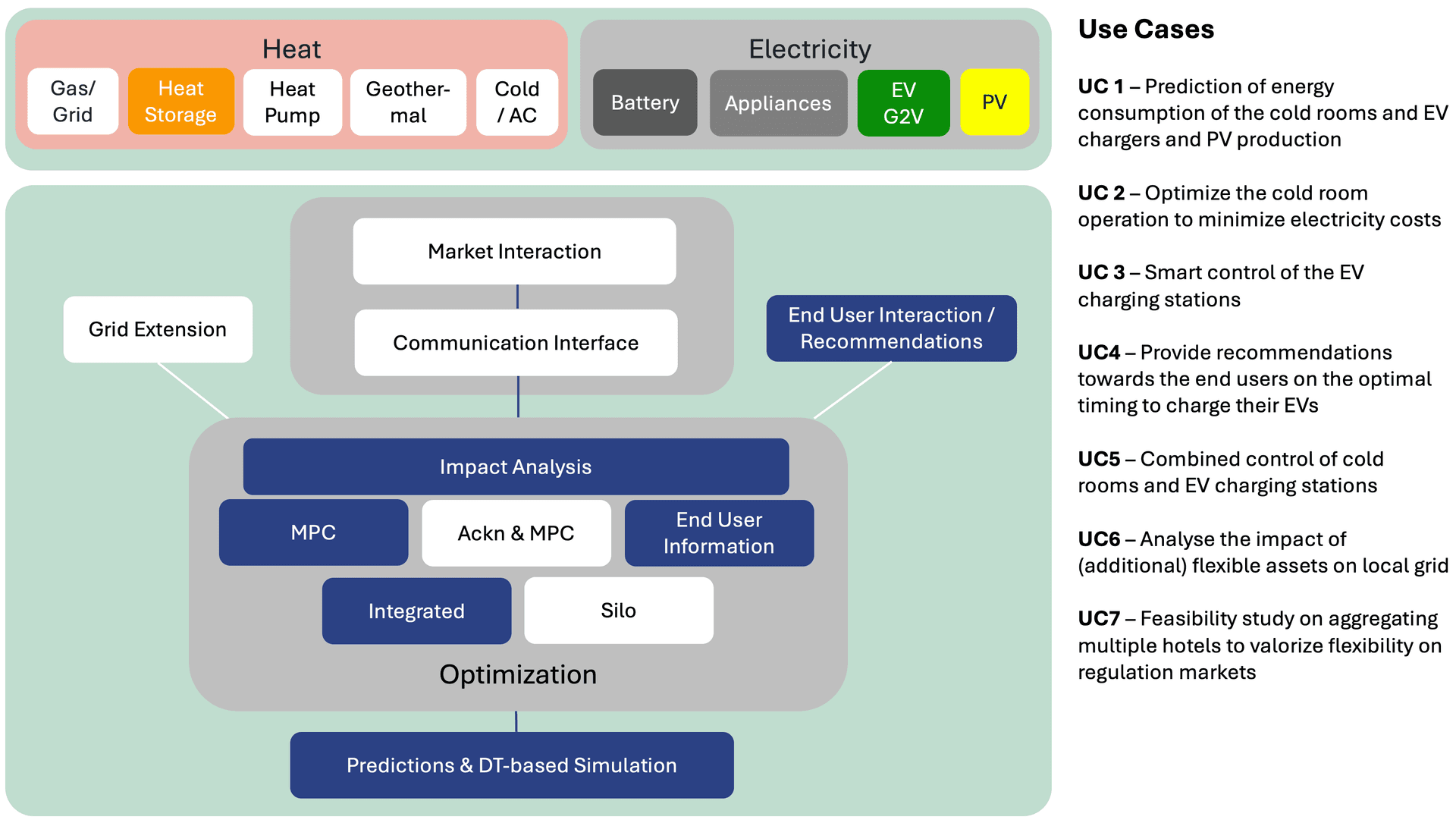
An analysis of the hotels identified two main flexible assets: cold storage and EV charging. These assets are modelled and optimized using their digital twins and PV forecasting, following the Bluebird approach of viewing each building and its systems as an integrated whole. This integrated view allows us to determine the most suitable operating strategy and the most effective energy market valorization strategy.

Flexibility from Hotel Charging Infrastructure
With the increase of EVs in Germany, more and more hotels invest in charging infrastructure. In this pilot, four charging stations are installed at each hotel. While EV drivers usually charge upon arrival, we try to gain flexibility through a user interaction in which the user grants a smart-charging time frame according to their preferences. The intervention is also designed to analyze driver behaviour and incentives for flexible smart charging in this scenario.
Flexibility from Cold Storage
The hotels, with their large kitchens, need refrigeration infrastructure. The thermal inertia of the cold-storage rooms will be exploited for flexibility when operating the refrigeration compressors. This is already a common approach for larger systems. In Bluebird, the economic viability of flexibilizing these small- to medium-sized systems and the potential for aggregation for different energy markets will be analyzed.
Flexibility Relieves the Grid
Finally, it will be analyzed how flexibility can relieve the grid. In the future, potentially critical PV generation peaks could be balanced with EV load peaks by using flexibility in the charging of electric vehicles.